
Thick Film Heater
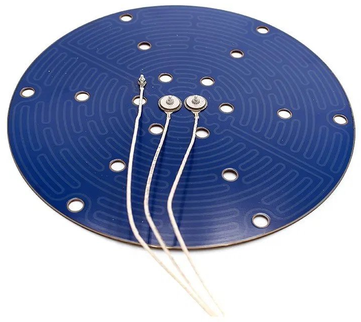
Thick film heaters are available on two substrate families, each suited to different temperature ranges, thermal performance, and form factor requirements.
- Stainless steel (SS430) — substrate rated to 500 °C; complete heater assemblies typically operate up to 350 °C, limited by lead wire termination. Weldable, mechanically robust, and the standard choice for high-volume liquid heating and panel heating.
- Alumina ceramic — up to 800 °C, high thermal conductivity, and excellent dielectric strength. The substrate of choice for fast-response heating in semiconductor, medical, and analytical instruments. See our Alumina ceramic heater page for details.
Why Choose Thick Film Heaters#
While most heating elements are built around an insulated foil or wire that must then be bonded to a separate heat sink, thick film heaters take a fundamentally different approach: the heating circuit is fired directly onto the structural substrate, making the heater and heat sink one integrated component.
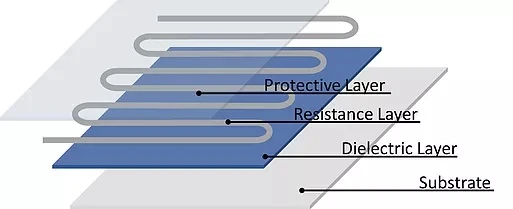
Direct substrate integration for superior heat transfer. In a conventional heater assembly, thermal resistance at the interface between heater and heat sink is a limiting factor. Thick film technology eliminates this interface entirely — the resistive circuit is fired directly onto the substrate, which conducts heat immediately into the target medium. This makes thick film heaters the preferred choice for flow-through liquid heaters, instant hot water dispensers, and any application where response time and efficiency are critical.
Substrate and geometry tailored to the application. Available on stainless steel or ceramic substrates and in flat, curved, or tubular form factors, thick film heaters can be designed as a structural component of the final product rather than an add-on element — reducing part count, assembly cost, and overall device size.
How Thick Film Heaters Are Made#
Thick film manufacturing begins with the substrate, which is first coated with a glass-ceramic dielectric layer to electrically isolate the heating circuit. A resistive paste is then screen-printed onto the dielectric in the designed circuit geometry, followed by firing at high temperature (typically 800–900 °C) to fuse the paste into a durable, bonded circuit. Conductive terminal pads and a protective overglaze are added in subsequent print-and-fire cycles, completing the heating element as an integral part of the substrate.
Because the resistive circuit, dielectric, and substrate are all fused into a single fired assembly — with no adhesive bonds, mechanical clamps, or thermal paste — there is no interface thermal resistance between the heat source and the structural surface that delivers heat to the target medium.
Steel Substrate: Why SS430#
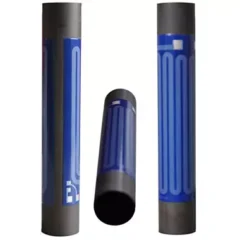
Stainless steel is the most widely used substrate for thick film heaters, and within stainless steel grades, ferritic 430 is the industry standard. Two material properties explain this choice.
Thermal expansion compatibility#
SS430 ferritic stainless steel has a coefficient of thermal expansion (CTE) of approximately 10.4 µm/m·K — moderately higher than the 6–8 µm/m·K of typical glass-ceramic dielectric coatings. This small mismatch is by design: after firing and cooling, the dielectric layer ends up in slight compressive stress, which ceramics tolerate very well. Higher-CTE substrates would produce tensile stress in the dielectric, eventually leading to cracking and delamination during thermal cycling.
Oxide layer adhesion#
At thick film firing temperatures, SS430 forms a thin, dense chromium oxide (Cr₂O₃) layer on its surface. This oxide acts as a chemical bonding interface between the metal substrate and the glass-ceramic dielectric undercoat, producing strong, durable adhesion that withstands both mechanical stress and thermal cycling.
Why not 304 or 316?#
Austenitic stainless steel such as 304 (CTE ≈ 17 µm/m·K) and 316 expand far more than the dielectric coating during firing and operation, producing tensile stress in the dielectric that leads to cracking and delamination over time. Their less stable oxide layer adds a secondary adhesion issue. For these reasons, ferritic SS430 is the dominant choice for thick film heater substrates.
Thick Film vs. Other Heater Types#
| Steel Thick Film | Mica Heater | Silicone Rubber Heater | |
|---|---|---|---|
| Max temperature | 350 °C | 500 °C | 200 °C |
| Watt density | ≤ 30 W/cm² (typ. 5–20) | ≤ 10 W/cm² | ≤ 3 W/cm² (with heat sink) |
| Substrate | mostly SS430 | Mica plate | Silicone rubber |
| Heat sink integration | Built-in | Separate | Separate |
| Form factor | flat, curved, tube | flat, curved | complex 3D |
| Best for | Flow-through, panels | Industrial heating | Contoured surfaces |
When Use Alumina Substrate, Not Steel?#
For thick film heaters, alumina substrate is the choice when:
- Operating temperature exceeds 350 °C
- Chemical resistance to acids, alkalis, or solvents is required
- Electrical isolation must withstand >1500 V
- The target media is purity-sensitive (medical, semiconductor, food contact)
For lower-temperature, high-volume applications with good chemical environment, steel-substrate thick film offers better mechanical robustness and lower cost.
Applications#
- AC line voltage heating: flow-through liquid heaters, radiators, heating panels
- Power electronics: braking resistors, load banks, energy dissipation assemblies
- Food & beverage: dispensers, instant hot water units, home appliances
- Automotive: EV battery heater, cabin heating, comfort systems
- Semiconductor: wafer processing equipment
- Packaging: heat-sealing and strapping machines
- Analytical instruments: DNA analyzers, laboratory heating blocks